
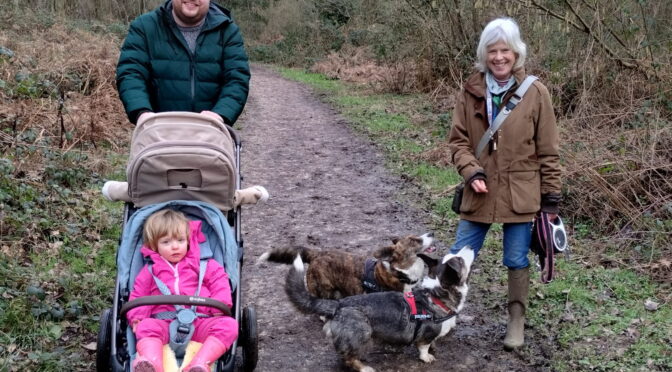
In the six years since we last posted about dog walking in Oakley Wood, there have been many changes. Those to the fabric of the wood are most obvious – the improved path around the perimeter, thinning of the conifers and new tree planting throughout.
It’s easy to see the increased number of visitors to the wood, partly triggered by the COVID pandemic and more recently by the improved perimeter path. A spot census on one Sunday in October 2023 counted almost 200 people on the path at the south end of the wood, and most with dogs. Given that there would likely be other visitors starting from the small Crematorium car park who didn’t take the longest path around the wood, we can be pretty sure that the actual number of visitors on that day would have been higher.
A less apparent change is the reduction in some wildlife. The trail camera has given us a history of animal sightings in the wood, and from this data we can get an idea of how different species are faring. When the camera first went into the wood 10 years ago it recorded foxes and badgers frequently; now fox sightings are uncommon, and badgers even more so.
You have to believe that the two are linked.
Oakley Wood is an amenity for the public that people can enjoy and walk their dogs, and the increase in footfall shows how much the wood is valued, and this is to be welcomed. But it is also a nature reserve and so there has to be a balance to be struck. Dogs and wildlife often don’t mix well. For this reason, people are encouraged to keep to the recognised paths and leave the wilder parts of the wood as a sanctuary for wildlife. We try to place the trail camera away from places where people walk (we’re not interested in pictures of the wrong sort of “wildlife”) but increasingly wherever we put the camera, it picks up dogs running loose, and sometimes chasing deer.
There’s little doubt in my mind that dogs at large in the wood are the major reason for the reduction of foxes and badgers (deer, especially muntjac, seem to be less affected) and letting dogs run loose should be discouraged. At this time of the year it is also a problem for ground-nesting birds. It is time, I think, for dog walkers to keep to recognised paths, with their dogs under “reasonable” control – not necessarily on leads but not running amok into the undergrowth.
Chris
Having walked my dogs at Oakley wood off lead for the past 14 or so years, I can’t say that I see many dogs ‘running amok in the undergrowth’ most dogs off lead are well trained and stick to the paths. I would suggest that potentially it is more likely the amount of humans, not just with dogs, traversing the woods that has put off the badgers, although I know nothing about their habits to say for sure. We have ground nesting birds on St Mary’s land in Warwick and the council fence off certain areas where they nest. Perhaps that could be done at Oakley as an easy win to start, maybe identify a badger safe area also to be fenced off.
Good afternoon. Having read your article, I agree that some areas could be reserved for dog free zones. However, this proposal sounds a lot more restrictive and I feel that the basis for the decision making is fundamentally flawed. I walk in Oakley a lot and have very rarely seen dogs straying from the well trodden paths through the middle of the wood. There will always be the odd one or two but I feel strongly that the decline in wildlife in recent years is much more likely to have been caused by the John Deere excavator removing great swathes of woodland and, before that, the heavy plant used to create the outside perimeter paths. You say that the deer have been less affected which makes absolute sense to me as they do not reside in setts or dens which would have been severely affected by the recent work and heavy plant being used. I’m all for protecting nature and introducing rules where needed but dogs seem to getting the blame for an awful lot recently and I think that your analysis is flawed and does not consider the other more likely factors. For example, I have seen more evidence of badger activity on one of the paths near the north side of the wood which is arguably one of the more popular inner paths for dog walkers. Badgers are fairly bold creatures and the odd passing dog won’t put them off but huge vehicles and the vibration of heavy plant will!
The use of inner paths also creates a good separation when the wood is busier at weekends/holidays. It means that those with reactive dogs can still use the woods and people with children, pushchairs and mobility scooters don’t clash with dog walkers as much as they possibly would.
I think a proper ecological survey is needed rather than assuming that a few rogue dogs are to blame. We cherish Oakley as one of the few places we can go without feeling unwelcome. I would hate to see this changed for the wrong reasons.
Having been walking in Oakley woods for many years I have never seen any wildlife other than squirrels or birds and insects. I am a big supporter of wildlife but Oakley woods has recently been decimated by machinery. While I appreciate there are good reasons there has been significant destruction of large areas of woodland both on the ground and of the trees. There is often noise from these machines and the undergrowth is now much less dense so I am unsurprised to know that there is less wildlife. Is there an increase in wildlife in the limited areas where dogs aren’t permitted?
Perhaps the massive machinery that decimated large parts of the wood has been the issue. Or the higher volume of the M40 which is really annoying. But yes let’s blame dogs again..
I disagree Strongly with this piece and the reasoning behind it. Whilst dogs do run through Oakley woods, there needs to be far stronger evidence provided for stopping members of the public from letting their dogs run free, than simply stating that there appears to be a drop in the number of sightings of Foxes and Badgers in Trail cameras. This appears to be simply the personal opinion of one person or a small group
people than a fact based on any particularly robust factual evidence.
Anyone who walks in Oakley woods will
Know that the roads around the woods are not only extremely busy but also high speed roads. It is common knowledge that traffic on British roads is a huge killer of wildlife including both foxes and badgers. Please can you explain what investigations have taken place to establish the effects of traffic on the populations of foxes and Badgers in Oakley wood? I think it is far, far more likely that the heavy and fast moving traffic in such close proximity to the woods is responsible for the decrease you are seeing in wildlife in Oakley.
I believe that the presence of Muntjac being unaffected is a major indicator that your reasoning is flawed. Your own investigation reports that the trail cameras regularly pick up dogs chasing deer and Anyone who walks around Oakley wood knows that muntjac are out and about during the day when dog walkers use the paths as would confirm that they are regularly chased by dogs when the deer venture out of the inner parts of the wood and the areas cordoned off from dogs.
Badgers and Foxes hide away during the day, safe in dens and sets, out of the reach of the vast majority of dogs. If dogs were in fact the cause of the decrease in wildlife then Muntjacs and other deer would almost certainly be affected but by your own admission they are not. Therefore I cannot see, on the basis of the limited evidence gathered, how it can be fair and proportionate to ban all dog walkers from walking their dogs off lead.
To take an Action like this which is drastic and will greatly impact on the enjoyment of the woods for many, many residents of Warwickshire, it should rightly be based on far more sound reasoning supported by a wider range of properly gathered and scrutinised evidence.
Well, it’s good to see that people do read this website and have opinions!
First, let me say that this is a personal opinion, based on 25+ years of walking in the wood and 10 years of trailcam video footage, and is not necessarily the view of The Friends in general. I certainly don’t claim it to be scientifically rigorous, just based on a lot of observation.
Some of you suggested that what I’ve seen is just due to increased human activity, and I accept this could be the case. You also suggested that the disruption of woodland thinning operations are to blame, and this could also be true. Not I think for the relatively short time that it takes place, but as one commenter pointed out that this would be more disruptive to badgers and foxes that have static homes which could be destroyed, as compared with deer that are relatively mobile. So I’ll take one on the chin for jumping to the “dogs only” conclusion.
But people do seem to be reading a lot into what I wrote that I didn’t actually say. At no point did I suggest a ban on walking dogs off-lead, not that it is in the remit of The Friends to decide anyway (that would be a WKWT and WDC decision). What I did say was to recommend that dog walkers keep their dogs under close control, which the vast majority already do, and especially in the bird nesting season. This is advice consistently given by all wildlife organisations. It’s important to minimise disturbance to ground-nesting birds and we do have those in Oakley Wood.
Chris