
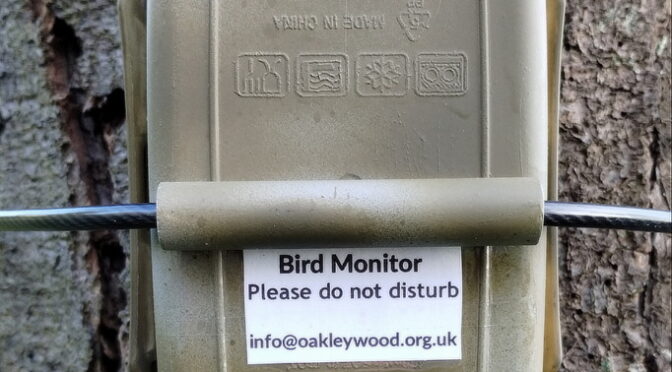
Last April I posted about AI bird recognition and the bird recorders we now have in the wood (here). By year-end they have captured roughly 600 hours of bird song, and AI analysis of these recordings has made 32,431 individual detections with a confidence level of 90% (we have enough data to concentrate just on the most promising). Below is the summary of those figures.
AI identification is by no means foolproof, although if the number of detections for a species is high, we could probably accept that as sole confirmation the species is present. For lower numbers, the need for supporting evidence gets greater. In practice, all species confirmed as present below have been verified by human observation of one form or another.
| Common Name | Scientific Name | Detections | Confirmed present? | Notes |
| Common Chiffchaff | Phylloscopus collybita | 9072 | Yes | |
| Eurasian Wren | Troglodytes troglodytes | 7738 | Yes | |
| European Robin | Erithacus rubecula | 2293 | Yes | |
| Eurasian Blackbird | Turdus merula | 1839 | Yes | |
| Coal Tit | Periparus ater | 1705 | Yes | |
| Goldcrest | Regulus regulus | 1282 | Yes | |
| Eurasian Blackcap | Sylvia atricapilla | 1194 | Yes | |
| Great Spotted Woodpecker | Dendrocopos major | 1009 | Yes | |
| Common Chaffinch | Fringilla coelebs | 986 | Yes | |
| Common Woodpigeon | Columba palumbus | 907 | Yes | |
| Song Thrush | Turdus philomelos | 671 | Yes | |
| Mistle Thrush | Turdus viscivorus | 618 | Yes | |
| Long-tailed Tit | Aegithalos caudatus | 517 | Yes | |
| Tawny Owl | Strix aluco | 459 | Yes | |
| Eurasian Blue Tit | Cyanistes caeruleus | 237 | Yes | |
| Spotted Flycatcher | Muscicapa striata | 216 | Yes | |
| Dunnock | Prunella modularis | 212 | Yes | |
| Eurasian Green Woodpecker | Picus viridis | 209 | Yes | |
| Eurasian Treecreeper | Certhia familiaris | 192 | Yes | |
| Common Raven | Corvus corax | 184 | Yes | |
| Redwing | Turdus iliacus | 151 | Yes | |
| Eurasian Jay | Garrulus glandarius | 83 | Yes | |
| Carrion Crow | Corvus corone | 74 | Yes | |
| Eurasian Siskin | Spinus spinus | 60 | Yes | Confirmed by Nick Martin |
| Eurasian Jackdaw | Corvus monedula | 55 | Yes | |
| Common Buzzard | Buteo buteo | 44 | Yes | |
| Short-toed Treecreeper | Certhia brachydactyla | 42 | Discounted | Unlikely, easily confused with other species |
| Common Crossbill | Loxia curvirostra | 42 | Yes | Confirmed by Nick Martin |
| Marsh Tit | Poecile palustris | 39 | Yes | |
| Great Tit | Parus major | 37 | Yes | |
| Common Redstart | Phoenicurus phoenicurus | 24 | Discounted | |
| Hawfinch | Coccothraustes coccothraustes | 19 | Discounted | Possible but would need sighting |
| Willow Warbler | Phylloscopus trochilus | 18 | Yes | |
| European Goldfinch | Carduelis carduelis | 15 | Yes | |
| Eurasian Nuthatch | Sitta europaea | 15 | Yes | |
| Eurasian/Green-winged Teal | Anas crecca | 14 | Yes | Occasional on pond |
| Eurasian Woodcock | Scolopax rusticola | 13 | Yes | Image captured by trailcam |
| Green Sandpiper | Tringa ochropus | 11 | Discounted | |
| Common Magpie | Pica pica | 11 | Yes | |
| Water Rail | Rallus aquaticus | 9 | Discounted | |
| Stock Dove | Columba oenas | 8 | Yes | |
| Northern Lapwing | Vanellus vanellus | 8 | Discounted | |
| Common Sandpiper | Actitis hypoleucos | 8 | Discounted | |
| Eurasian Oystercatcher | Haematopus ostralegus | 7 | Discounted | |
| Eurasian Curlew | Numenius arquata | 7 | Discounted | |
| Eurasian Bullfinch | Pyrrhula pyrrhula | 7 | Discounted | |
| Garden Warbler | Sylvia borin | 6 | Yes | |
| Eurasian Tree Sparrow | Passer montanus | 6 | Discounted | |
| European Pied Flycatcher | Ficedula hypoleuca | 5 | Discounted | |
| Common Greenshank | Tringa nebularia | 5 | Discounted | |
| Meadow Pipit | Anthus pratensis | 3 | Discounted | |
| Long-eared Owl | Asio otus | 3 | Discounted | |
| Common Pheasant | Phasianus colchicus | 3 | Yes | Surprisingly few detections |
| Common Moorhen | Gallinula chloropus | 3 | Discounted | |
| Yellowhammer | Emberiza citrinella | 2 | Discounted | |
| Whimbrel | Numenius phaeopus | 2 | Discounted | |
| Tree Pipit | Anthus trivialis | 2 | Discounted | |
| Gadwall | Mareca strepera | 2 | Discounted | |
| Common Redshank | Tringa totanus | 2 | Discounted | |
| Common Kingfisher | Alcedo atthis | 2 | Discounted | |
| Common Firecrest | Regulus ignicapilla | 2 | Discounted | |
| Black Redstart | Phoenicurus ochruros | 2 | Discounted | |
| Barn Owl | Tyto alba | 2 | Yes | |
| Whooper Swan | Cygnus cygnus | 1 | Discounted | |
| Whinchat | Saxicola rubetra | 1 | Discounted | |
| Western Yellow Wagtail | Motacilla flava | 1 | Discounted | |
| Rook | Corvus frugilegus | 1 | Discounted | |
| Red-legged Partridge | Alectoris rufa | 1 | Discounted | |
| Pied Wagtail/White Wagtail | Motacilla alba | 1 | Discounted | |
| Little Ringed Plover | Charadrius dubius | 1 | Discounted | |
| Little Owl | Athene noctua | 1 | Discounted | |
| Greylag Goose | Anser anser | 1 | Discounted | |
| Grey Wagtail | Motacilla cinerea | 1 | Discounted | |
| Grey Heron | Ardea cinerea | 1 | Discounted | |
| European Serin | Serinus serinus | 1 | Discounted | |
| European Golden Plover | Pluvialis apricaria | 1 | Discounted | |
| Common Swift | Apus apus | 1 | Discounted | |
| Common Snipe | Gallinago gallinago | 1 | Discounted | |
| Common Reed Bunting | Emberiza schoeniclus | 1 | Discounted | |
| Common Grasshopper Warbler | Locustella naevia | 1 | Discounted | |
| Barnacle Goose | Branta leucopsis | 1 | Discounted | |
| Total detections (90%) | 32431 | |||
| Total confirmed species: 39 |
Of course, just because we can’t confirm the odd detection doesn’t mean it’s impossible. For one thing, the recorders do record during the night, and it’s possible that migrating birds, especially waders, could be picked up as they fly overhead.
Some of the discounted species above are mis-identifications of more common birds or other sounds:
| Identified as | Actual |
| Common Redstart | Chiffchaff call |
| Northern Lapwing | Nuthatch or Song Thrush |
| Oystercatcher | Song Thrush |
| Cuckoo | Dog barking |
| Golden Plover | Song Thrush |
| Green Sandpiper | Chiffchaff call |
| Bluethroat | Robin |
| Short-toed Treecreeper | Blue or Coal Tit |
| Lesser Whitethroat | Blackcap alarm call |
| Water Rail | Song Thrush |
| Firecrest | Goldcrest (probably) |
I posed the question to my search engine’s AI: “What is the expected number of bird species in a small UK Midlands wood”. The answer it gave was 20-30, which, if correct, suggests that Oakley Wood is doing well.
What for 2026?
The main purpose of the recorders was to get a better idea of what species are present in the wood, and perhaps where. The first of these is pretty much been done (the table above). The recorders were moved around the wood to different locations during the year, so the data (yet to be analysed!) should also provide some idea of distribution.
I came across this article by the Woodland Trust about how a woodland had been monitored for increases in bird numbers as woodland management measures took effect. Many of the measures are similar to or the same as those being followed in Oakley Wood, and so it seems useful to now place the recorders in two permanent locations so data can be compared year-on-year (being optimistic that they will last that long!). Hopefully we should see similar increases as the improvements take effect.
Chris